Home
JD Features:

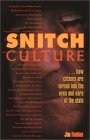
Buy it from this link and Justice Denied will receive a small percentage. Snitch Culture
Snitch Culture
By Jim Redden
Feral House
Venice, CA 2001
235 pagesReviewed by Hans Sherrer
Snitch Culture is a timely examination of how personal and technological snitching is used by the state and private organizations, in conjunction with informational databases, to obliterate the privacy of Americans. The author, Jim Redden, formerly published PDXS, a quasi-counterculture newspaper in Portland, Oregon.
Judas Iscariot is the most well known snitch in history. Mr. Redden relates in considerable detail how the state in general, and its law enforcement network in particular, is dependent on large numbers of people emulating Judas' example of snitching on Jesus Christ for 30 pieces of silver. They are also duly rewarded with enticements that can include a reduced sentence, dropped charges, informant payments and deflecting their guilt on to others.
The state's addiction to snitches is illustrated by the U.S. Supreme Court's decision in 1999 to let stand a lower court ruling in U.S. v. Singleton, that federal prosecutors are exempt from the federal statute prohibiting the bribery of witnesses to testify favorably for the government.
The book also relates horror stories of innocent people who have been victimized by snitches unconcerned with the truth. Their ordeals emphasize that everyone is endangered by the state's unrestrained purchase and reliance on questionable information from suspect sources.
Furthermore, when the state is unable to acquire information directly, it has long relied on the intelligence network of snitches working with private organizations, such as the Anti Defamation League and the Southern Poverty Law Center.
Mr. Redden points out that children are taught to snitch on each other and their parents by programs such as DARE, employees are encouraged to snitch on coworkers and their employers, lawyers snitch on clients, acquaintances and spouses snitch on each other, ad nauseam. Snitching is so epidemic in this country that it is becoming culturally ingrained.
For anyone skeptical of how easily and quickly "ordinary" people can be induced to become a snitch, Mr. Redden explains the chilling "Third Wave Experiment" a San Francisco area high school teacher conducted in 1967. In an April 2000 interview, the teacher recalled that in few days: "Students were becoming like the Gestapo and giving me personal information I could use against other students in class."
Mechanical and electronic snitching has a long history of augmenting personal snitching. Although not mentioned in the book, at the behest of the federal government a mechanical punch-card computer was invented in 1884 that aided the collection of information on Americans beginning with the census of 1890. When later controlled by IBM, that same technology assisted the German censuses of the 1930's and it eased the identification and rounding up of Jews and other undesirables. The passage of the Social Security Act in 1935 and the creation of a data file on most Americans and every business employing workers, encouraged development of the electronic computer: the first prototype of which was functional in 1939.
In the 1928 case of Olmstead v. U.S., the Supreme Court gave its approval to the state's use of electronic snitch devices to snoop on Americans. In his dissent, Justice Louis Brandeis warned of the Pandora's Box of privacy invasions the Court was opening. Mr. Redden explains that just seven decades later, Americans are subjected to pervasive forms of technological snitching from before their birth until after their death. Most of that covert surveillance and collection of information is conducted as a part of the daily routine of state agencies and private businesses and organizations.
There has been considerable publicity in the last few years that phone calls, emails, and even faxes of people are secretly monitored by State agencies, as well as employers who are not constrained by any 4th Amendment concerns. Although published in March 2001, snitching is expanding at such a rate that Mr. Redden doesn't mention the NSA's (National Security Agency) Tempest project that can read a computer screen from 1/2 mile away, that was written about in the April 20001 issue of Popular Mechanics. Neither does he mention the NRO's 25 billion dollar spy satellite project reported on page one of the LA Times of Mach 18, 2001. Those projects reflect one of the central themes of Snitch Culture: we often don't know when or how we are being watched or reported on.
Furthermore, untold thousands of businesses have improved on Radio Shack's rudimentary collection, beginning over 20 years ago, of information about its customers. State agencies are increasingly using information in private databases to fine-tune its own snitch projects. Mr. Redden also points out the irony that people who publicly express the fear of losing their rights are specifically targeted for state funded snitch programs that undermine those very rights.
Jeremy Bentham didn't apply his concept of the Panoptical prison to the surveillance of an entire society. However, the U.S. increasingly resembles just such a prison due to the institutionalization of state and private snitching. Given that environment, Snitch Culture provides a healthy counterbalance to the deafening crescendo that technology is "our friend". It is ushering in a brave new world, but one that has many ugly and disturbing qualities.
It can no longer be ignored that the technological surveillance portrayed in the chilling 1970 movie, Colossus: The Forbin Project, and in the book, The Year of Consent by Crossen (1954), is now more in the realm of possible and even the real, than it is of science fiction. Along with other science fiction of the 1950's and 60's, they prophesied that the ability of technological devices to snitch on people would affect their conduct, and the direction and "feel" of society.
This review only scratches the surface of the wealth of information in Snitch Culture and the breadth of its contents. Its last 60 pages, for example, are comprised of 9 case studies covering aspects of the snitching and surveillance Americans have been and are continuously being subjected to. A valuable addition to future editions would be an index and a bibliography that are noticeably absent from the first edition.
Snitch Culture is a significant contribution to the growing body of criticism related to state sponsored and private spying, invasions of privacy, and the law enforcement networks dependency on closing case files by purchasing tainted information and testimony. Mr. Redden succeeds in painting a horrific portrait of the central role snitching has in the surveillance state the U.S. has become. The book is worth reading by those wanting to increase their awareness of how their life is, and will continue to be, impacted by state and private surveillance, intelligence networks and snitching techniques.
Snitch Culture can be ordered by mail for $18.45 ($14.95 + $3.50 s/h) from:
Feral House P.O. Box 13067 Los Angeles, CA 90013-0067It can be ordered online from bn.com (Barnes and Noble), amazon.com, and other web sites. Feral House's web site is at: www.feralhouse.com
©Justice: Denied